“Put that stick down!”
“No chasing!”
“Don’t pretend to shoot!”
Many parents and early childhood providers have found themselves saying something like this when children start playing superheroes, chasing one another, or turning a stick into a pretend sword.
Play with fighting, weapons, and “good guys and bad guys” can feel uncomfortable for adults. It can also raise real safety questions: Is everyone having fun? Does each child want to play? What should adults do when the game gets too rough?
There isn’t one rule that works for every family or child care program. Some families and providers allow pretend weapon play with clear limits. Others choose not to allow it. What matters is setting expectations that fit your setting and responding consistently when children’s safety or comfort is at risk.
What is playful aggression?
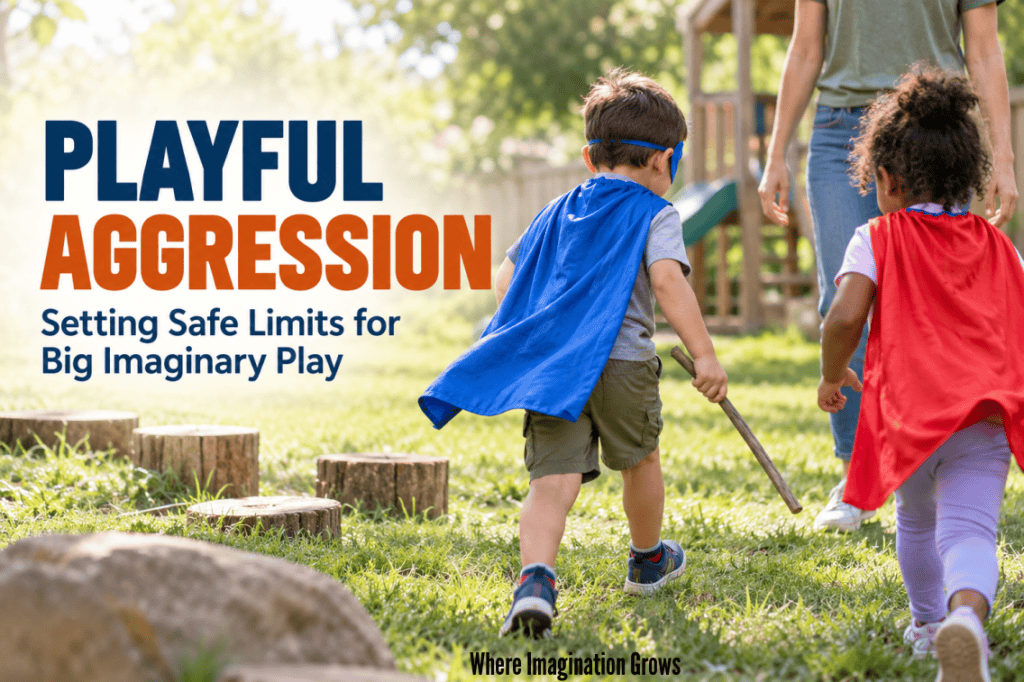
Playful aggression is pretend or energetic play that includes themes such as chasing, fighting, capturing, rescuing, or pretending to be a superhero. Children might use toy props, sticks, blocks, or imaginary objects as part of a story.
The play may look intense, but the important question is what the children are doing and how they are responding to one another. A pretend game with shared roles and made-up rules is different from a child ignoring another child’s “stop,” hitting in anger, or trying to hurt someone.
Children’s play can also change quickly. A game that begins as fun may become too loud, too physical, or upsetting for one of the children. Adults need to stay close enough to notice that change.
Does aggressive play mean a child is becoming violent?
Pretend play by itself does not tell you what a child will be like as an adult. One study found that childhood weapon play was not useful as a stand-alone indicator of later criminal behavior. That finding doesn’t show that every kind of pretend play is harmless, or that adults should ignore what happens during a game. It’s one reason to pay attention to the whole situation instead of labeling a child based on a single kind of play.
Children may choose dramatic or action-filled stories for many reasons. They might enjoy the movement, want to take on a powerful role, be copying a character, or be testing out ideas through make-believe. Adults can ask what’s happening in the game rather than assuming they know what it means.
How to tell when the play is working
As you watch children play, consider:
- Are the children choosing to participate?
- Are they listening when someone says “stop” or “I don’t want to play”?
- Are they taking turns with roles, or is one child always forced to be the “bad guy”?
- Can they keep their bodies and props away from other people’s faces?
- Do they calm down when an adult gives a reminder?
- Is the play staying within the rules of your home, classroom, or program?
The answers can help you decide whether to keep observing, remind children of the rules, redirect the game, or stop it.
Set clear rules before play begins
Children need simple, specific boundaries. You might say:
- “Pretend play is okay. Hitting, kicking, and pushing are not.”
- “Keep sticks below your waist and away from people.”
- “Ask before you use a prop with someone else.”
- “If anyone says ‘stop,’ the game stops.”
- “Everyone gets to choose whether they play.”
- “You can pretend to capture someone, but you can’t hold them down.”
- “If the game gets too rough, we’ll take a break.”
Choose rules that make sense for the ages of the children, your space, and your program’s policies. For younger children, you may need to repeat the rules during play and demonstrate what safe play looks like.
When to step in
Step in promptly if a child is hurt, frightened, or trying to leave the game; if someone is being targeted or pressured; or if children are using props in a way that could cause injury. Stop the play if children can’t follow the agreed rules after reminders.
Use a calm, direct response:
“I’m stopping the game. The stick came too close to someone’s face. We can try again with the stick on the ground, or choose a different game.”
If a child is upset, check on them first. Later, when everyone is calm, help the children talk about what happened and decide whether they want to play together again.
You can also help children change the story without dismissing their idea. For example, a superhero game might become a rescue mission, a search for a missing animal, or a plan to help someone in trouble. NAEYC describes teachers using children’s superhero interests to extend the play while supporting awareness of other people’s space and safety.
A note about sticks and pretend weapons
Sticks can be interesting outdoor materials, but they can also poke, trip, or injure someone. Before children use them, consider the size and condition of the sticks, the number of children playing, and whether there is enough open space. Set clear rules, supervise closely, and put the sticks away if children can’t use them safely.
Families and providers may have different boundaries around toy weapons or pretending to shoot. It’s okay to decide that those games don’t fit your home or program. If you do allow pretend weapon play, make the limits clear and keep all real firearms completely inaccessible to children. The American Academy of Pediatrics recommends that firearms in homes be locked and unloaded, with ammunition locked separately. Read the AAP’s firearm storage guidance.
Talk with families about your policy
For child care providers, it helps to explain your approach before a child enrolls. Tell families what kinds of play you allow, what rules you use, and how you respond when a game becomes unsafe, or a child doesn’t want to participate.
Parents may have strong feelings about pretend fighting or toy weapons. A clear conversation gives everyone a chance to decide whether your program’s approach is a good fit. You can include relevant expectations in your parent handbook and review them as part of enrollment.
For help writing clear program expectations, see my post on creating a home daycare contract and policy handbook. You may also find it helpful to read what parents should expect from their daycare provider.
There isn’t one rule for every family or program
Some adults are comfortable allowing superhero games and pretend weapons with clear safety limits. Others prefer to redirect those themes. Either approach can work when children are supervised, boundaries are clear, and adults respond when someone is uncomfortable or unsafe.
Instead of focusing only on whether a game looks aggressive, watch how the children treat one another. Are they listening? Are they willing to stop? Is everyone still enjoying the play? Those observations can help you decide what support the children need in the moment.
I agree with you. Pretending is such an important part of being a child. Thank you speaking out about this.
Such an important topic! My daughter is just now starting to get into pretend shooting and gun play and I let her though I don't like it! Play is how kids work things out and understand their world. Gun play and "aggressive" play is part of it.
brilliant post. I am with you on this one. It doesn't always feel comfortable when my son is playing 'gun' play. But he needs that outlet. The whole sticks are dangerous thing really irritates me, from an early age I always taught my son to point sticks at the floor when running, and to avoid other people's faces. He has never injured another child with a stick, where as kids who
I agree with you on this one. Especially for boys, sometimes a show of aggression is part of their 'play' and yes, by playing different roles they do realise what it's like to be on different ends of the behavioral spectrum. A little roughhousing is okay with me, as long as it is supervised. After all, we can't expect kids to be anything but kids! Found you on The Sunday Parenting
I agree with you also. My sons are 5 and 3 and my husband and I don't have a problem at all with them playing with sticks, play weapons, or good guys/bad guys. Children have been doing imaginary play since the beginning of time and it hasn't been a problem. My parents played imaginary play with me when I was a young girl (fishing, cowboys and outlaws, camping, grocery store, etc.) and it
I’m loving this! Right on!
http://www.aznannies.com